Mental Health · Writing

One Thing

Slow – Hwy 101 old growth” © Sam Bebee, 2005. CC BY 2.0.

I tell myself to do just one thing. Put clothes on. Eat something. Open up my computer and write a sentence, a word. One thing. Just one.

Then I think of how it will compound. How one thing leads to another and that’s how everything gets built. I lose track quickly of how important just focusing on the first step is. I start to zoom in on how all those little pieces will join together to make something I deem worthwhile. Then I’m not thinking about each individual part anymore. I’m thinking about the entire lifespan of the thing. Seeing the tree in the seed.

But there are seeds that never become trees at all. And trees that never soar above me. Never make me feel safe and small and powerful and insignificant all at once. Trees that turn into tables or door frames. Paper for notebooks. Trees that burn in fires. That live high in mountains, where the air is thin, and put in everything they can, but never get over three feet tall.

And I’m reminded not to get too caught up in the building. Not to cling too hard to the idea that one thing always becomes another and another. Or that it always needs to. Sometimes one thing is just that. You write one sentence and then you curl up on the floor and sob for the rest of the day. And that’s okay.

You don’t have to get bogged down by the bigness of the possibility. Not every word has to be part of the next great American novel. Not every day has to be dripping with productivity. Has to have tangible accomplishments to point to.

Not every seed exists to become towering.
Mental Health

Rev

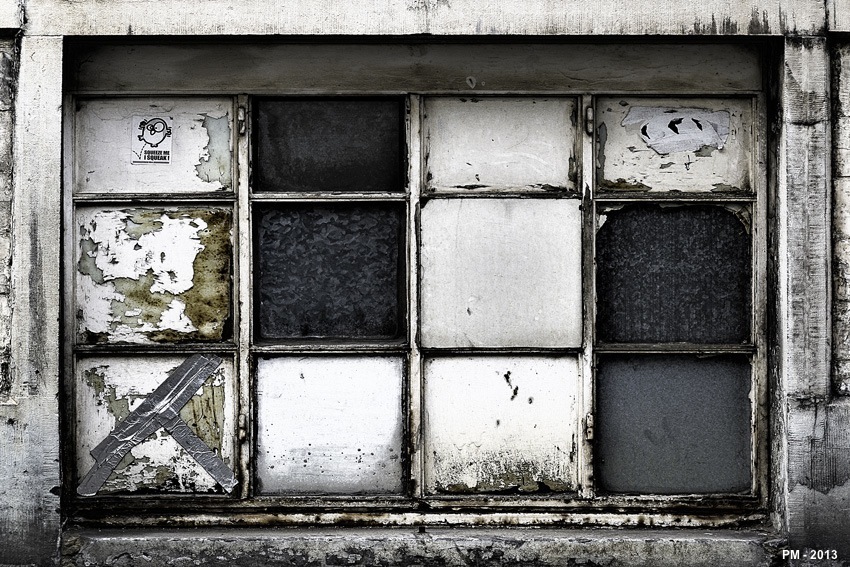
window” © Patrick Marioné, 2013. CC BY-NC-ND 2.0.
It’s hopeless. Empty. You turn the key over again and again, but the car still doesn’t start.

You’ve tried everything. The things that used to work don’t work anymore. Frayed rope wrapped around your knuckles. Hang on to it.

At the end of the day I stand in the kitchen and stare at a counter full of dirty dishes. Knees weaken, my throat catches. It’s just too much. Like everything. Paralysis. And I catch myself wondering if any of it matters anyway.

The medication, the therapy, the long walks around the lake. The exercise, the diet. The writing, the communication, the skill-building. The revised work schedule, the closed windows. Firing on all cylinders, but still feeling nothing.

I put my hands on Mason’s shoulders and look up at him. “I can do this, right? Tell me things will be different.” He does. Pulls me tight into him again. Kisses the top of my head and rocks me softly.

Alyssa texts me reminders of the things I love. Tells me about the passionate and beautiful parts of myself that are just tired and quiet, not gone forever. Promises this isn’t my new permanent.

So I take a deep breath. I pick up a dirty spoon, a fork, a knife. I take the plates and put them in the dishwasher. The glasses, too. I wipe the counter and spray out the sink. Everything is monumental and I’m just not big enough. But one piece at a time, I do it anyway.

Mental Health · Relationships

Soften

soft landing” © ankakay, 2009. CC BY 2.0.
I packed up my things at the coffee shop, rationing breaths. Used words sparingly. I’d reached the edge.

Kissed Mason and threw an, “I love you,” over my shoulder as I charged down the steps. Picked up momentum as I headed across the street, back toward our apartment. Counted cracks in the sidewalk, steps. Watched my feet dodge in and out of my line of vision. Held my breath. Clamored through the front door, made it to the elevator, lost it.

An hour later he opened the door and found me still laying on the floor. Catatonic. Dropped his bag and draped himself over me. I immediately started sobbing again.

That’s the world we’ve been living in.

As a writer, I felt I should be able to find words for it. The hot anger, the senseless desperation, the hopelessness. The ever-resurfacing frustration with the person I seem to be. Instead, I looked across the bathroom floor at my wonderful husband, eyes big and mascara-stained. I said, “I don’t know if I can do this.”

Each word crashed in the space between us and I collapsed on top of them. Curled into his chest, clawed for air, for stability. He tilted my head up toward his, eyebrows bearing down and voice tight around the edges, “You can. You’re okay. It’s okay. Everything’s okay.”

All folded in on myself and rendered immobile, I clung onto his t-shirt. Slowed my breathing.

I don’t know how to believe him.

But his arms pinned mine to my sides and he rocked me. And I knew he believed himself. And that’s enough for now.