Guest Posts · Mental Health

Guest Post: Wake Up Call

"DSC_0087" © Harvy, 2012. CC BY-NC-ND 2.0.
DSC_0087” © Harvy, 2012. CC BY-NC-ND 2.0.

You heard it before you knew what was happening, before you were even fully conscious, opening your eyes to the dark and to the sound. A ghostly sob behind hypnopompic curtains, fuzzing into your dream like an alarm clock. And maybe it was an alarm, in a way. Not the ring-ring-ring kind, but an alarm of another variety. An alert, a Mayday signal from your subconscious, saying wake up and feel this.

You woke after the crying had already started, the pillow wet beneath your cheek. You tried to keep the noise down, so as not to wake him. Because you wanted to be polite in your grief, because you didn’t want him to ask. Because you didn’t know the answer.

But you also needed to get it out. Out of your body as if it were something you could retch up from your stomach and out your throat. It would come out heavy and hard because that’s how long it’s been sitting there. Shoved down, stuffed down, pressed harder and harder into a ball. Your own personal diamond.

What happened to you? What is going on in those delta waves? When did this start? You never used to do this, did you?

No. I didn’t.

–––––

Shannon Noel Brady is a multi-genre author of novels and short stories. Her blog muses on the craft of writing with pieces of fiction interspersed.

Would you like to have your work featured on this blog? Send an email to rubyabrowne[at]gmail.com.

Autobiography · Mental Health · Personal Development

Nurture

"pink wooly love" © Dorky Mum, 2010. CC BY-NC-ND 2.0.
pink wooly love” © Dorky Mum, 2010. CC BY-NC-ND 2.0.

In November of 2013 I was happy. I like to hold onto that month in my memory as proof that it’s possible. Evidence I can shake this ache from my bones and stand up strong. I carry that idea around with me like a seed, try to supply it with what it needs to grow. But it’s mostly guesses as to how this all works. How to properly nurture it.

I know I was getting up at the same time every day and exercising at least forty minutes. Mason and I were doing a Whole30, so we were eating well and I was cooking most of our meals. I was also participating in NaNoWriMo. But that’s all I can remember about that month. Those things and the fact that I was happy.

Could happiness be so simple? Something that wraps itself into our daily activities like brushing our teeth or checking the mail. Perhaps it slinks in and out of our lives attached to simple habits we didn’t think made much of a difference at the time. Maybe it’s not all just the whim of brain chemicals and hormones. Maybe it’s the day-to-day things.

It both needs to be simple and couldn’t possibly. Could I get that feeling back just by working out, cooking, and writing a book? If I think it’s that easy, why I can’t I get myself to do those things? The strong hand of depression closes around me so tight I can’t seem to make the movements I need to free myself.

All of it sounds so easy in theory. Get up in the morning, go run, go to work, write, cook dinner. But each one feels so monumental when you’re wrapped up in it. When you’re in the midst of depression, nothing seems like it would make a difference. The things you know help don’t matter, because you can’t make yourself believe any of the things you know. But maybe I could start.

Maybe I could get myself to remember it’s the little things that make a difference. Maybe I could get myself to remember it’s simple steps in the right direction that get you to where you’re going. I don’t need an entire garden, just a little bit of soil.

Book Reviews

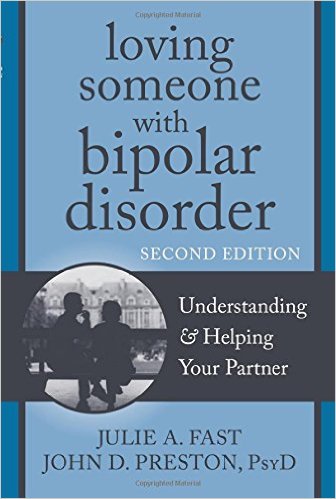
Book Review: Loving Someone with Bipolar Disorder

51ANHaURwAL._SX334_BO1,204,203,200_ This week I read a great book from Julie A. Fast and John D. Preston, PsyD called Loving Someone with Bipolar Disorder. Though I’m the one with bipolar disorder in my family, this book had a lot of great insight on managing the disease and making life as stable and healthy as possible for my partner and me.
 
One of the biggest takeaways for me was the idea of mourning the loss of a “normal” relationship (whatever that even is), so you can move forward in your relationship as a bipolar affected couple. I’d never considered how important it was to just kind of accept that our lives are always going to be different than the lives of those who don’t have to deal with bipolar disorder every day. I wanted to pretend that wasn’t the reality, brace against it hard as I could. I like the idea of mourning the loss and moving on.
 
The major theme throughout the book is the idea of treating bipolar disorder first. Every day you have to make sure you’re doing everything you can to manage the disease and that’s really all there is to it. I’ve often wanted to pretend I could let my bipolar treatment fall to the wayside and just live my life, but this book really brought it home that that’s not an option for me. There’s something always relieving about someone else telling me I have to do that. Permission to take care of my illness first. How liberating.
 
Overall, I thought the book was full of lots of great information, both for people with bipolar disorder and for those who love them. Though it’s geared toward partners, I’m sure that parents, siblings, and friends could all learn a lot about the illness from it. I’ll definitely be recommending it again and againo